A few months ago, I probably wouldn’t have paid much attention to a supplement called FemiPro.
Not because bladder health isn’t important.
Quite the opposite.
It’s because the supplement market has become so crowded that most products start to look the same after a while.
A flashy website.
A few impressive claims.
Some customer testimonials.
And a promise that life is about to get dramatically better.
So when I started noticing people searching “does FemiPro really work“ over and over again, my curiosity kicked in.
The question itself tells you something important.
People aren’t asking where to buy it.
They aren’t asking how much it costs.
They’re asking whether it actually works.
That’s a completely different conversation.
And honestly, it’s the conversation that matters most.
Because if you’ve ever spent money on a supplement that didn’t live up to expectations, you know exactly how frustrating that experience can be.
You start hopeful.
You follow the instructions.
You wait for results.
Then weeks later, you’re staring at a bottle wondering whether you wasted your money.
That’s why I wanted to approach this topic differently.
Instead of repeating marketing claims, I wanted to understand why women are interested in FemiPro in the first place and whether there’s enough evidence to suggest it’s worth considering.

Why So Many Women Are Looking for Answers
One thing became obvious almost immediately during my research.
Most women searching “does FemiPro really work” aren’t looking for perfection.
They’re looking for relief.
There’s a difference.
Nobody wakes up one morning excited to research bladder support supplements.
Usually, there’s a reason.
Maybe it’s waking up several times a night because of urinary urgency.
Maybe it’s the stress of always knowing where the nearest restroom is located.
Maybe it’s avoiding long drives, flights, or social events because bladder issues have slowly started controlling daily life.
Those situations don’t always make headlines, but they affect millions of women across the United States.
And they often affect confidence in ways people rarely discuss openly.
That’s why products like FemiPro attract attention.
Not because they’re trendy.
Because they offer hope that things might improve.
The First Thing That Caught My Attention
When I first looked at FemiPro, one detail stood out immediately.
The company talks a lot about something called the urinary microbiome.
If you’ve never heard that term before, you’re not alone.
Most people are familiar with gut health.
Probiotics have become mainstream.
Walk into almost any grocery store today and you’ll find products promoting digestive wellness.
But researchers have increasingly started exploring bacterial ecosystems in other parts of the body as well.
Including the urinary tract.
That’s one reason FemiPro takes a slightly different approach than many traditional bladder support products.
Instead of focusing exclusively on symptoms, the formula appears designed around supporting a healthier urinary environment overall.
Whether that approach delivers meaningful results is still the big question.
But from a research standpoint, it immediately made the product more interesting than many generic supplements I come across.
Does FemiPro Really Work for Everyone?
Let’s address the biggest misconception surrounding supplements.
Many people assume products fall into one of two categories.
Either they work.
Or they don’t.
Real life is usually more complicated.
The truth is that no supplement works exactly the same way for every person.
Age matters.
Lifestyle matters.
Hormones matter.
Sleep quality matters.
Diet matters.
Existing health conditions matter.
That’s why you’ll often see completely different experiences from two people using the same product.
One woman may notice meaningful improvements.
Another may experience moderate benefits.
A third may notice very little change.
That doesn’t necessarily mean someone is lying.
It simply reflects the reality of human biology.
So when people ask, “Does FemiPro really work?” the more accurate question might be:
“Does FemiPro provide enough support for some women to notice meaningful improvements?”
Based on available information, the answer appears to be yes.
But expectations remain important.
Looking Beyond the Sales Page
One thing I’ve learned after researching health products for years is that sales pages rarely tell the entire story.
They’re designed to highlight strengths.
That’s their job.
What interests me more is what’s actually inside the formula.
Because ingredients often reveal far more than marketing headlines.
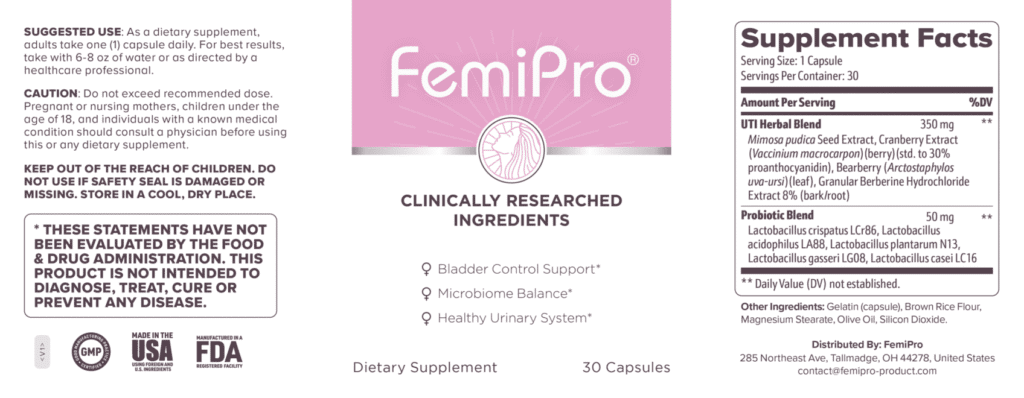
FemiPro contains several ingredients commonly associated with urinary wellness.
Cranberry extract is perhaps the most recognizable.
For decades, women have used cranberry-based products as part of urinary health routines.
The formula also includes probiotics, which align with the product’s microbiome-focused approach.
Other ingredients such as Bearberry and Berberine have long histories within wellness communities.
Now, does the presence of these ingredients automatically prove effectiveness?
Of course not.
But it does suggest that the formula wasn’t randomly assembled.
There appears to be a clear strategy behind its design.
And that’s something I always look for when evaluating supplements.
The Real Reason Some Women Report Positive Results
Something interesting happened while I was reading through customer experiences.
The women who reported the best outcomes rarely described overnight transformations.
Instead, many described gradual changes.
Sleeping a little longer before needing to get up.
Feeling slightly more comfortable during long outings.
Experiencing fewer interruptions during the day.
In other words, the improvements often sounded realistic.
And strangely enough, that’s what made them more believable.
Whenever I see reviews claiming a supplement completely transformed someone’s life within 48 hours, my skepticism increases.
Real wellness improvements tend to happen incrementally.
They’re often noticed only after looking back and realizing something that used to happen constantly isn’t happening as often anymore.
Those are the types of experiences I encountered most frequently while researching FemiPro.


So, Does FemiPro Really Work?
At this stage of my research, here’s my honest opinion.
FemiPro appears to be a legitimate bladder support supplement built around ingredients that have established histories within urinary wellness products.
The formula appears thoughtfully designed.
The microbiome-focused approach is interesting.
And the customer feedback suggests that some women experience meaningful benefits.
Does that mean every woman will achieve the same results?
No.
No honest reviewer could promise that.
But if the question is simply:
“Does FemiPro really work?”
The evidence suggests that many women believe it does.
The more important question is how well it works, who is most likely to benefit, and whether the results justify the cost.
That’s exactly what I’ll explore in the next section.
The Moment I Stopped Thinking About Ingredients
Something unexpected happened while researching whether FemiPro really works.
I found myself caring less about the ingredient list.
Not because ingredients don’t matter.
They absolutely do.
But after a while, I realized that most women aren’t buying FemiPro because they’re fascinated by probiotics or botanical extracts.
They’re buying it because they’re frustrated.
That’s the word that kept coming back to me.
Frustrated.
Frustrated with interrupted sleep.
Frustrated with planning every outing around restroom access.
Frustrated with feeling older than they actually are.
And perhaps most of all, frustrated with the idea that they simply have to accept these issues as a normal part of life.
That emotional reality explains why products like FemiPro continue gaining attention.
The supplement isn’t being sold as a luxury.
For many women, it’s being considered as a possible solution to a daily annoyance that’s quietly stealing quality of life.
What I Think Most Reviews Get Wrong
After reading dozens of supplement reviews online, I noticed a pattern.
Most articles focus almost entirely on what a product claims to do.
Very few spend time discussing what consumers should realistically expect.
That’s a problem.
Because unrealistic expectations create disappointment.
Imagine someone reading a review that makes FemiPro sound like a miracle.
They place an order.
They take it for a week.
Nothing dramatic happens.
Immediately they assume it doesn’t work.
But wellness doesn’t usually happen that way.
Think about exercise.
Most people don’t go to the gym three times and wake up looking completely different.
Progress tends to be gradual.
The same principle often applies to supplements.
The women who reported positive experiences with FemiPro frequently described small improvements that accumulated over time.
Not overnight transformations.
Not dramatic breakthroughs.
Just gradual changes that eventually became noticeable.
To me, those stories felt more authentic.
A Question Worth Asking
Whenever someone searches “does FemiPro really work,” I think there’s actually a second question hiding underneath.
The hidden question is:
“Can I trust this product enough to try it?”
Those are two very different questions.
Effectiveness and trust are not identical.
A supplement might contain quality ingredients and be manufactured responsibly while still producing mixed results among users.
That’s normal.
Human biology is incredibly complicated.
What impressed me most during my research wasn’t a specific claim.
It was the overall level of transparency.
The company doesn’t appear to hide its ingredient list.
It discusses manufacturing standards.
There’s a refund policy.
And there are enough details available for consumers to perform their own research.
Those factors matter.
A lot.
Why Some Women May Notice Better Results Than Others
This is probably the least exciting part of the discussion.
It’s also one of the most important.
When people ask whether FemiPro works, they often assume every user starts from the same place.
They don’t.
Consider two hypothetical women.
One experiences occasional urinary urgency but otherwise enjoys good health.
Another has dealt with bladder-related concerns for years while also managing other health challenges.
Would it be reasonable to expect identical results?
Probably not.
Lifestyle factors matter.
Hydration matters.
Sleep quality matters.
Physical activity matters.
Even stress can influence how people feel from day to day.
That’s why supplement outcomes often vary more than consumers expect.
This isn’t unique to FemiPro.
It’s true across the entire wellness industry.
Understanding that reality helps create more realistic expectations.
And realistic expectations generally lead to better decision-making.
The Part Nobody Likes Talking About
Let’s address the uncomfortable truth.
Some people won’t be satisfied with FemiPro.
There.
I said it.
Every legitimate product has disappointed customers.
That’s unavoidable.
No supplement has a 100% success rate.
No wellness product produces identical experiences for everyone.
Whenever I see a review claiming otherwise, I become suspicious.
The existence of dissatisfied customers doesn’t automatically mean a product is ineffective.
It simply means human beings are different.
Ironically, the presence of mixed feedback often makes positive reviews more believable.
Because that’s what real life looks like.
Some people are thrilled.
Some people are neutral.
Some people move on and try something else.
That’s normal.
The Refund Policy Changed My Perspective
I wasn’t planning to pay much attention to the refund policy.
Then I started thinking about it differently.
Imagine two companies.
One refuses refunds entirely.
The other allows customers to try a product and request a refund if they’re unhappy.
Which company appears more confident?
Exactly.
A money-back guarantee doesn’t prove effectiveness.
But it does reduce consumer risk.
For someone sitting on the fence and wondering whether FemiPro is worth trying, that matters.
A lot.
Especially because bladder support supplements aren’t usually impulse purchases.
Most buyers have spent weeks researching before making a decision.
If My Sister Asked Me About FemiPro
I often use this thought experiment when reviewing products.
If someone close to me asked whether they should consider FemiPro, what would I say?
I wouldn’t promise results.
I wouldn’t describe it as a miracle.
And I definitely wouldn’t claim it solves every urinary health concern.
What I would say is this:
The formula appears legitimate.
The ingredients make sense within the context of bladder and urinary wellness.
The company provides more transparency than many competitors.
And there are enough positive experiences available to suggest that some women genuinely find value in it.
Would I tell someone to replace medical advice with a supplement?
Absolutely not.
But would I dismiss FemiPro as a scam?
Based on everything I’ve seen, no.
Not even close.
So Where Do I Stand Right Now?
At this point in my research, my answer to the question “Does FemiPro really work?” is surprisingly straightforward.
For some women, it appears to.
For others, the results may be more modest.
And for a smaller group, it may not deliver the improvements they hoped for.
That isn’t a flaw unique to FemiPro.
That’s simply the reality of wellness products.
The more important takeaway is that nothing I’ve found suggests the product is misleading consumers or operating like a scam.
Instead, FemiPro appears to be a legitimate supplement attempting to address bladder wellness through a combination of traditional urinary-support ingredients and a modern microbiome-focused approach.
Whether that approach is worth the investment ultimately depends on the individual woman considering it.
But based on my research so far, it’s a question worth exploring rather than dismissing outright.