A few months ago, I helped a friend compare several GLP-1 weight loss programs.
The conversation started exactly where most conversations start.
Price.
Not side effects.
Not eligibility.
Not medication options.
Price.
The first thing she asked was:
“How much does Gala GLP-1 actually cost?”
Honestly, I understood the question.
Healthcare decisions are important, but budgets matter too.
Most people don’t have unlimited money to spend on weight loss programs, no matter how motivated they are.
That’s why searches for Gala GLP-1 price continue to grow.
People want straight answers before investing their time and money.
Unfortunately, finding those answers isn’t always easy.
Different websites list different numbers.
Some mention promotional pricing.
Others discuss annual plans.
A few focus on monthly subscriptions.
Before long, what should be a simple question becomes surprisingly confusing.
So let’s talk about it.
Not like a salesperson.
Not like a marketing page.
Just like two people trying to understand what something really costs.

Why Price Matters More Than People Admit
I’ve noticed something interesting about weight loss discussions.
People often feel guilty talking about money.
They’ll spend hours discussing diet plans.
They’ll compare medication options.
They’ll research side effects.
But when it comes to cost, they sometimes act like it shouldn’t matter.
I disagree.
Price absolutely matters.
A treatment can be effective, convenient, and medically supervised.
But if you can’t comfortably afford it long term, that’s important information.
Weight loss isn’t usually a one-week commitment.
It’s often a months-long journey.
Sometimes longer.
Which means affordability becomes part of the conversation whether people want to discuss it or not.
The First Mistake Most People Make
Here’s the mistake I see over and over again.
People focus only on the monthly number.
That sounds logical.
But it can be misleading.
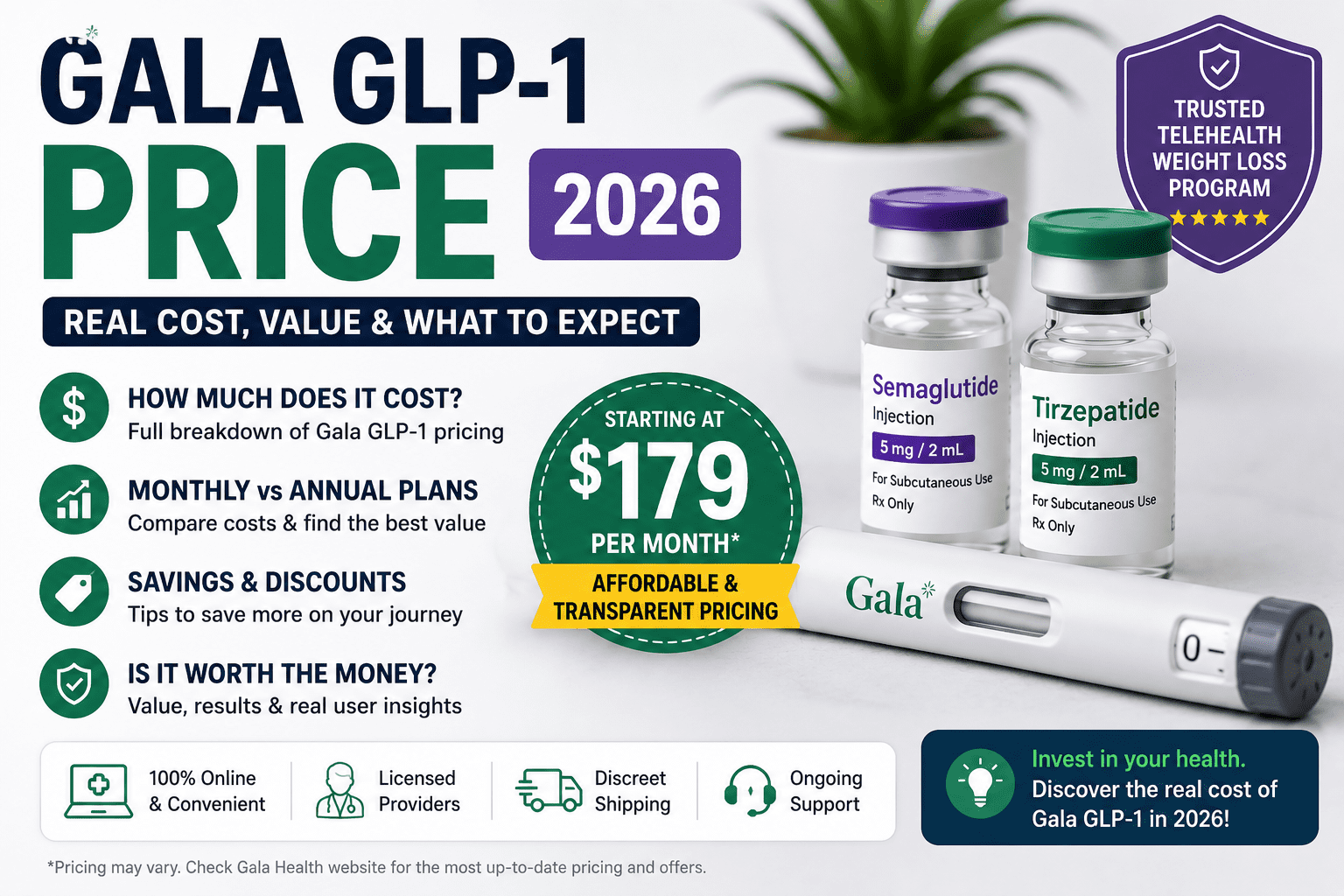
Imagine someone tells you a program costs $179 per month.
At first glance, that seems straightforward.
Then you discover there are setup costs.
Or promotional discounts.
Or annual-plan pricing.
Or different medication options.
Suddenly the calculation changes.
The smartest approach isn’t asking:
“What’s the monthly price?”
It’s asking:
“What will I realistically spend over six months or a year?”
That’s usually the more useful number.
Why Pricing Seems Confusing
Part of the confusion comes from how healthcare pricing works.
Different patients may qualify for different treatment paths.
Some may choose semaglutide.
Others may choose tirzepatide.
Some people prefer lower-dose introductory programs.
Others begin with more traditional treatment structures.
Because of that, there isn’t always one simple answer.
And honestly, that frustrates consumers.
People like certainty.
They want a clear number.
The healthcare world doesn’t always provide one.
My Honest Reaction to Gala GLP-1 Pricing
When I first started researching Gala GLP-1 price information, I expected to see something outrageous.
Maybe that’s because so many headlines about weight loss medications focus on extremely expensive treatments.
What I found instead was something more nuanced.
The pricing wasn’t necessarily cheap.
But it wasn’t nearly as shocking as some traditional alternatives either.
That’s an important distinction.
Affordable doesn’t mean free.
Affordable doesn’t even mean inexpensive.
It simply means more accessible than some of the alternatives people are comparing it against.
Looking Beyond the Price Tag
Something I wish more people discussed is value.
Price and value are not the same thing.
Let’s say two programs cost roughly the same amount.
One includes provider support, medication management, follow-up guidance, and ongoing communication.
The other doesn’t.
Which one is cheaper?
That’s actually the wrong question.
The better question is:
Which one delivers more value?
Sometimes spending slightly more can produce a better overall experience.
Sometimes it can’t.
The point is that price alone rarely tells the entire story.
What Real People Usually Want to Know
When people search for Gala GLP-1 price, I don’t think they’re really asking about numbers.
At least not entirely.
I think they’re asking something deeper.
They’re asking:
“Is this realistic for someone like me?”
That’s a different question.
And honestly, it’s a more useful one.
Because affordability isn’t universal.
A price that feels reasonable to one person may feel impossible to another.
Neither perspective is wrong.
Financial situations differ.
Priorities differ.
Goals differ.
That’s why personal context matters so much.
The Cost of Waiting
Here’s a thought that doesn’t get discussed often.
Sometimes people spend so much time searching for the perfect deal that they never make a decision at all.
I’ve done this myself with completely unrelated purchases.
Hours of research.
Dozens of comparisons.
Endless reviews.
Weeks pass.
Nothing happens.
At some point, the search becomes more comfortable than the decision.
I’m not suggesting anyone rush into healthcare choices.
Far from it.
Research is important.
But there comes a moment when more research stops being useful and starts becoming avoidance.
Only you can decide where that line is.
The Emotional Side of Pricing
Money conversations are rarely just about money.
They’re emotional.
Especially when health is involved.
Many people feel frustrated that improving their health can be expensive.
Some feel angry.
Others feel discouraged.
A few feel overwhelmed.
Those emotions are understandable.
Healthcare costs affect real people making real decisions.
That’s why transparency matters.
People deserve clear information before committing to any program.
What Surprised Me Most
The biggest surprise during my research wasn’t the pricing itself.
It was how differently people reacted to the exact same numbers.
One person described the program as affordable.
Another called it expensive.
Same service.
Same pricing.
Completely different conclusions.
Why?
Because value is personal.
Someone who has spent years trying different approaches may view the cost differently than someone just beginning their journey.
Someone comparing Gala to premium alternatives may see one thing.
Someone comparing it to traditional healthcare routes may see another.
Context changes everything.
Questions Worth Asking Yourself
Before focusing exclusively on price, I think it’s worth considering a few questions.
What are you comparing it to?
What alternatives have you already tried?
How important is convenience?
How much value do you place on provider access?
Would paying less but receiving less support actually help you?
These questions don’t eliminate the importance of cost.
They simply add perspective.
A Quick Reality Check
No weight loss program is perfect.
No pricing model is perfect.
And no healthcare decision is completely risk-free.
Anyone promising otherwise is probably selling something.
The goal isn’t finding perfection.
The goal is finding an option that aligns with your needs, budget, and expectations.
That’s a much more realistic target.
Final Thoughts
When people search for Gala GLP-1 price, they’re often looking for certainty.
A simple answer.
A straightforward number.
But the truth is slightly more complicated.
Cost matters.
Value matters.
Convenience matters.
Support matters.
Personal circumstances matter.
The right decision usually comes from considering all of those factors together rather than focusing on a single number.
Because at the end of the day, healthcare decisions are rarely about price alone.
They’re about finding something you can realistically sustain over time.

Is Gala GLP-1 Expensive? Honestly, It Depends
I know that’s probably not the answer people want.
Most readers are hoping for a simple yes or no.
But after spending time researching Gala GLP-1 price information, I don’t think the answer is that straightforward.
Expensive compared to what?
That’s the real question.
Compared to a gym membership?
Yes.
Compared to cooking meals at home?
Absolutely.
Compared to some premium GLP-1 programs and brand-name medications?
Not necessarily.
Context changes everything.
And that’s exactly why pricing discussions online can become so confusing.
Two people can look at the exact same number and reach completely different conclusions.
The Monthly Cost Isn’t the Whole Story
This is where many buyers get tripped up.
They focus entirely on what they’ll pay this month.
But long-term healthcare decisions rarely work that way.
Imagine spending less money on a program that you quit after six weeks.
Was it really cheaper?
Maybe.
Maybe not.
Now imagine spending slightly more on a program you actually stick with for six months.
The total investment may be higher, but the overall value could be significantly greater.
This is why I always encourage people to think beyond the first payment.
The first payment is rarely the most important one.
The months that follow matter much more.
Something Most Review Articles Ignore
Here’s a question I rarely see discussed.
What is the cost of doing nothing?
Seriously.
Think about it.
People spend hours comparing prices.
Weeks reading reviews.
Months waiting for the perfect opportunity.
Meanwhile, nothing changes.
Again, I’m not suggesting anyone rush into a decision.
Healthcare deserves careful consideration.
But there is a difference between thoughtful research and endless delay.
At some point, waiting has a cost too.
Not always a financial cost.
Sometimes it’s a progress cost.
Why Some People Feel the Price Is Worth It
After reading user experiences, I noticed a pattern.
People who felt satisfied with the program rarely talked about the monthly charge by itself.
Instead, they talked about what they received in return.
Convenience.
Provider access.
Support.
Structure.
Accountability.
For them, the value wasn’t limited to medication.
It was the entire experience.
That’s an important distinction because value is often more emotional than mathematical.
Two people can spend the same amount and feel completely differently about the purchase.
Why Others Think It’s Expensive
Of course, not everyone feels the same way.
Some people look at the cost and immediately decide it’s too high.
That’s understandable.
Everyone has different financial responsibilities.
Different priorities.
Different budgets.
What feels manageable for one household might feel unrealistic for another.
Neither perspective is wrong.
Personal finance is personal.
That’s why I generally avoid telling people whether something is expensive.
Only you can decide that.
The Hidden Cost Nobody Mentions
The hidden cost isn’t always money.
Sometimes it’s expectations.
I’ve seen people spend significant amounts on weight loss programs expecting dramatic results within a few weeks.
When reality doesn’t match those expectations, disappointment follows.
And disappointment feels expensive.
Even if the actual price was reasonable.
This is one reason realistic expectations matter so much.
The more realistic your expectations, the more accurately you can evaluate value.
A Thought About Comparison Shopping
I think comparison shopping is healthy.
In fact, I encourage it.
But comparison shopping becomes dangerous when it turns into comparison obsession.
Some people compare so many programs that they become overwhelmed.
Every option starts looking similar.
Every review sounds familiar.
Every price point feels confusing.
Eventually they stop making progress altogether.
At some point, information stops helping.
And starts creating paralysis.
That’s a difficult balance.
What Would I Look At First?
If I were personally comparing options, price wouldn’t actually be the first thing I examined.
It would probably be the second or third.
I’d start with:
Does the program fit my goals?
Do I understand how it works?
Am I comfortable with the overall approach?
Only after answering those questions would I focus heavily on cost.
Because the cheapest program in the world isn’t useful if it doesn’t align with what you’re trying to accomplish.
The Most Honest Answer I Can Give
People often ask:
“Is Gala GLP-1 worth the money?”
The honest answer is that nobody can answer that for you.
Not me.
Not a reviewer.
Not a social media influencer.
Not even someone who had a fantastic experience.
The only person who can determine value is the person paying for it.
And that person is you.
Reviews can help.
Research can help.
Comparisons can help.
But eventually the decision becomes personal.
Frequently Asked Questions About Gala GLP-1 Price
Is Gala GLP-1 cheaper than brand-name GLP-1 medications?
Many people consider telehealth GLP-1 programs because they may cost less than some brand-name alternatives. However, pricing can change, so always verify current rates directly before enrolling.
Does the price stay the same forever?
Not necessarily.
Healthcare pricing changes.
Promotional offers expire.
Programs evolve.
Always review the latest information before making decisions.
Is there a free trial?
Program terms can change over time, so check current enrollment details directly through the provider.
Does insurance cover Gala GLP-1?
Coverage options vary widely. Many people using telehealth weight-loss services choose self-pay options, but eligibility and reimbursement situations can differ.
Should price be the main factor?
Personally, I don’t think so.
Price matters.
But support, convenience, accessibility, and long-term sustainability matter too.
My Final Verdict
After spending considerable time researching Gala GLP-1 price information, I keep coming back to the same conclusion.
The number itself is only part of the story.
People naturally focus on monthly costs because numbers are easy to compare.
But healthcare decisions rarely come down to numbers alone.
The real question isn’t:
“How much does it cost?”
The real question is:
“Does the value justify the cost for me?”
That’s a much harder question.
But it’s also the more useful one.
For some people, the answer will be yes.
For others, it won’t.
And that’s perfectly okay.
The goal isn’t finding a program that works for everyone.
The goal is finding a program that works for you.
Because at the end of the day, the best investment isn’t necessarily the cheapest one.
It’s the one that supports the goals you’re genuinely committed to achieving.